Hi folks -- cow-orker Adam informs me that today, Friday, May 4th (as every first Friday in May), is No Pants Day.
Alas, I will only be participating in spirit.
Check out their list of events, and their FAQ (which address the thorny issue that, in British English, "pants" means underwear, so it would be "No Trousers Day")
Thanks -- Joe
Friday, May 4, 2007

Thursday, May 3, 2007
The Onion on the Secret Conceit of Bloggers
This week's edition of online humor site The Onion has an opinion piece that could come from the keyboard of many a blogger: "If Someone Wanted To Publish My Blog Entries For Money, I Wouldn't Say No" (Safe For Work, but one of the ads in the rotation has a bad word).
Even though most of us blog for ourselves and our immediate circle of friends and family, who among us doesn't harbor some small, secret spark that our writings will get discovered for their staggeringly insightful/heartbreakingly poignant/bitingly sarcastic/uproariously hilarious observations contained within?
(It's kind of like, "If you blog it, they will come.")
Written by blogger "Ben Tiedemann" (of Ben Tiedemann Tells All -- it's blank, don't bother looking), it's all about how the writer specifically does not have fantasies about getting featured by Esquire, or writing for the New York Times' Arts & Leisure section, or getting a syndicated column, or landing a 3-picture movie deal, because someone serendipitously discovered the genius that was his blog.
As fantasies go, it ranks up there with getting discovered by a talent agency on your trip to the supermarket -- it happens... but probably not to you.
But as long as it doesn't get in the way of your blogging, or your life, why not?
If you got discovered because of your blog, would you turn down your chance for blog fame, or would you take the money and run?
Thanks -- Joe
Even though most of us blog for ourselves and our immediate circle of friends and family, who among us doesn't harbor some small, secret spark that our writings will get discovered for their staggeringly insightful/heartbreakingly poignant/bitingly sarcastic/uproariously hilarious observations contained within?
(It's kind of like, "If you blog it, they will come.")
Written by blogger "Ben Tiedemann" (of Ben Tiedemann Tells All -- it's blank, don't bother looking), it's all about how the writer specifically does not have fantasies about getting featured by Esquire, or writing for the New York Times' Arts & Leisure section, or getting a syndicated column, or landing a 3-picture movie deal, because someone serendipitously discovered the genius that was his blog.
As fantasies go, it ranks up there with getting discovered by a talent agency on your trip to the supermarket -- it happens... but probably not to you.
But as long as it doesn't get in the way of your blogging, or your life, why not?
If you got discovered because of your blog, would you turn down your chance for blog fame, or would you take the money and run?
Thanks -- Joe
Firetrucks: Never a Good Sign, and Some Followups
Hey folks -- here's a photo from on-campus, about an hour ago:
Since there was also an ambulance, and no smoke or alarms, I can only assume it was some sort of medical emergency. Hope everyone's all right.
Next, following up on a few items from yesterday:
* On Milblogging Restrictions: The Washington Post has two related items -- a feature article, "Blogs Chronicle War from Soldiers' Perspectives", and a live Q&A chat transcript featuring the article author and a milblogger, Sean Dustman of Doc in the Box (who will be at Saturday's MilBlog Conference).
* Also, looking at the HD-DVD Digg Dustup, the Electronic Frontier Foundation (better known as the EFF -- they're an online rights group) has a legal primer on the whole HD-DVD thing, which may provide a little more insight into the legal issues behind all this.
Thanks -- Joe
Annoyingly, there was something on either the lens or the window.

Since there was also an ambulance, and no smoke or alarms, I can only assume it was some sort of medical emergency. Hope everyone's all right.
Next, following up on a few items from yesterday:
* On Milblogging Restrictions: The Washington Post has two related items -- a feature article, "Blogs Chronicle War from Soldiers' Perspectives", and a live Q&A chat transcript featuring the article author and a milblogger, Sean Dustman of Doc in the Box (who will be at Saturday's MilBlog Conference).
* Also, looking at the HD-DVD Digg Dustup, the Electronic Frontier Foundation (better known as the EFF -- they're an online rights group) has a legal primer on the whole HD-DVD thing, which may provide a little more insight into the legal issues behind all this.
Thanks -- Joe
Wednesday, May 2, 2007
The Digg Users Were Revolting
This next story is supremely interesting for those of us involved with the development and moderation of communities, especially looking at how communities behave given tools, rules and norms.
Last night, there was a big dust-up over at social link sharing site Digg. (Digg in a nutshell: Users submit links to interesting sites, and other users vote them up or down. The highest voted, or "dugg" stories make it to the front page of the site, which is highly visible and drives a lot of traffic. Users can also comment on the stories. The site is kind of a Web 2.0 darling, and it features a very tech-centric, not to mention, young, audience.)
Now, there's a 16-character hexadecimal encryption key (basically, a sequence of 32 letters and numbers) going around that Linux hackers can use to "crack" the anti-copying measures on High Definition DVDs (HD-DVD).
(These anti-copying measures are generally known as Digital Rights Management, or DRM. A lot of people hate DRM with a passion, since while it's supposed to hinder piracy, it also gets in the way of legitimate users who try to make backup copies, or watch DVD movies on their iPods or whatever.)
Some links to HD-DVD crack Web sites were featured on Digg, so the HD-DVD people (the AACS) sent Digg a takedown notice. Under the Digital Millennium Copyright Act (DMCA), bad things can happen to Web sites if they don't comply with takedown notices. So Digg started taking down the HD-DVD articles, and banning the accounts of people who kept reposting them.
The Digg users didn't like that very much.
They started submitting and digging so many HD-DVD stories, that for a while, every link on the main page of Digg featured the encryption key.
(Check out the BBC News article for a good summary of events.)
In the face of this user revolt, eventually, the Digg folks said: Okay -- you win: We're going to stop taking down the stories and deal with the consequences.
Naturally, those of us in the online community business are watching this with interest, not only because the DMCA affects us, too, but because sites that depend on community and user-generated content have to figure out what to do whenthe users don't want to play by the rules any more, and in essence, start to make their own.
After all, it's a pretty clear-cut rule violation (even if you don't think the DMCA is a very good law -- and a lot of people don't), so Digg could technically get sued into oblivion (unless the law gets changed).
I'm not an expert in intellectual property law (or much of anything else), so here are some reactions from around the Internet:
* Fark.com's Drew Curtis says that they don't have the venture capital millions to fight a legal battle which could "crush [them] into a fine paste", so they'll continue deleting violator's posts (but they will try to help Digg in their legal battle, if they can).
* TechCrunch's Michael Arrington says "Vive La Revolution" in 'Digg Surrenders to Mob'.
* Over at PaidContent.org, Staci Kramer writes that the lesson is:
* Interestingly, BoingBoing's Cory Doctorow, who is pretty much an anti-DRM zealot, complied with his own takedown request on lawyer's advice.
* Here's the discussion thread over at Plate-of-Beans-Overthinker site Metafilter
* Tech industry gossip blog Valleywag characterizes this as another episode of social media navel-gazing (they have a summary of events, too -- with some swearing)
So, like I said, it's an interesting (not to mention complicated) story, since it touches on intellectual property, social media, and the wisdom of crowds/madness of mobs.
It's notable, though, that the DMCA is kind of a big, fat target, and that DRM isn't exactly a sympathetic party to this crowd.
What is more interesting, I think, is to see what lasting, downstream effects this has, and how communities can deal with similar situations when the lines aren't so clearly defined and the target isn't so universally reviled.
Thanks -- Joe
Last night, there was a big dust-up over at social link sharing site Digg. (Digg in a nutshell: Users submit links to interesting sites, and other users vote them up or down. The highest voted, or "dugg" stories make it to the front page of the site, which is highly visible and drives a lot of traffic. Users can also comment on the stories. The site is kind of a Web 2.0 darling, and it features a very tech-centric, not to mention, young, audience.)
Now, there's a 16-character hexadecimal encryption key (basically, a sequence of 32 letters and numbers) going around that Linux hackers can use to "crack" the anti-copying measures on High Definition DVDs (HD-DVD).
(These anti-copying measures are generally known as Digital Rights Management, or DRM. A lot of people hate DRM with a passion, since while it's supposed to hinder piracy, it also gets in the way of legitimate users who try to make backup copies, or watch DVD movies on their iPods or whatever.)
Some links to HD-DVD crack Web sites were featured on Digg, so the HD-DVD people (the AACS) sent Digg a takedown notice. Under the Digital Millennium Copyright Act (DMCA), bad things can happen to Web sites if they don't comply with takedown notices. So Digg started taking down the HD-DVD articles, and banning the accounts of people who kept reposting them.
The Digg users didn't like that very much.
They started submitting and digging so many HD-DVD stories, that for a while, every link on the main page of Digg featured the encryption key.
(Check out the BBC News article for a good summary of events.)
In the face of this user revolt, eventually, the Digg folks said: Okay -- you win: We're going to stop taking down the stories and deal with the consequences.
Naturally, those of us in the online community business are watching this with interest, not only because the DMCA affects us, too, but because sites that depend on community and user-generated content have to figure out what to do whenthe users don't want to play by the rules any more, and in essence, start to make their own.
After all, it's a pretty clear-cut rule violation (even if you don't think the DMCA is a very good law -- and a lot of people don't), so Digg could technically get sued into oblivion (unless the law gets changed).
I'm not an expert in intellectual property law (or much of anything else), so here are some reactions from around the Internet:
* Fark.com's Drew Curtis says that they don't have the venture capital millions to fight a legal battle which could "crush [them] into a fine paste", so they'll continue deleting violator's posts (but they will try to help Digg in their legal battle, if they can).
* TechCrunch's Michael Arrington says "Vive La Revolution" in 'Digg Surrenders to Mob'.
* Over at PaidContent.org, Staci Kramer writes that the lesson is:
"In other words, community first — even when it breaks your own rules, business second. This time. No clue as to what Digg will do the next time it's faced with a take-down request on another topic but it's clear who actually holds the power in this equation. What that means for business — not so clear."* Gizmodo called it a "Digg Riot" and posted screenshots.
* Interestingly, BoingBoing's Cory Doctorow, who is pretty much an anti-DRM zealot, complied with his own takedown request on lawyer's advice.
* Here's the discussion thread over at Plate-of-Beans-Overthinker site Metafilter
* Tech industry gossip blog Valleywag characterizes this as another episode of social media navel-gazing (they have a summary of events, too -- with some swearing)
So, like I said, it's an interesting (not to mention complicated) story, since it touches on intellectual property, social media, and the wisdom of crowds/madness of mobs.
It's notable, though, that the DMCA is kind of a big, fat target, and that DRM isn't exactly a sympathetic party to this crowd.
What is more interesting, I think, is to see what lasting, downstream effects this has, and how communities can deal with similar situations when the lines aren't so clearly defined and the target isn't so universally reviled.
Thanks -- Joe
Looks Like We'll Have Lots to Talk About at the MilBlog Conference
So, I wasn't 100% sure until now, but I'll be attending the 2007 MilBlog Conference this Saturday in Arlington, VA (it's only about 15 miles away).
I wasn't sure if I'd be going since I'm not focused on military community stuff, but it is a blogging conference after all. (Though it means, unfortunately, that I won't be able to catch this year's running of the Baltimore Kinetic Sculpture Race. You can't have everything -- where would you put it?)
And it looks like there'll be a lot to talk about -- Wired's Danger Room blog reports on new restrictions on military blogs (generally known as "milblogs"):
The article goes on to say that the new restrictions [PDF file] cover blogs, e-mail, comments and message board postings, and also affect civilian employees, contractors, and even military families.
The reason for the new restrictions is to maintain OPSEC -- Operational Security. The military is concerned that soldiers who blog might reveal information that an enemy could exploit. It's "Loose Lips Sink Ships", updated for the 21st century soldier.
As many have commented, the military is there to "protect democracy, not practice it", and that soldiers give up certain rights when they join up. And censorship of correspondence has been widely practiced ever since soldiers have been able to write letters home.
However, others argue that milblogging is valuable not only to soldiers and their families, but so that we people at home can get a real sense of the costs of war.
On a practical matter, blanket prohibitions never seem to work very well (especially when it comes to the Internet), so I suspect we'll see a continued evolution of this policy.
In the meantime, I've updated the iconic "Someone Talked!" World War II poster for the modern era:
Thanks -- Joe
I wasn't sure if I'd be going since I'm not focused on military community stuff, but it is a blogging conference after all. (Though it means, unfortunately, that I won't be able to catch this year's running of the Baltimore Kinetic Sculpture Race. You can't have everything -- where would you put it?)
And it looks like there'll be a lot to talk about -- Wired's Danger Room blog reports on new restrictions on military blogs (generally known as "milblogs"):
"The U.S. Army has ordered soldiers to stop posting to blogs or sending personal e-mail messages, without first clearing the content with a superior officer, Wired News has learned. The directive, issued April 19, is the sharpest restriction on troops' online activities since the start of the Iraq war. And it could mean the end of military blogs, observers say."[Original link via Slashdot]
The article goes on to say that the new restrictions [PDF file] cover blogs, e-mail, comments and message board postings, and also affect civilian employees, contractors, and even military families.
The reason for the new restrictions is to maintain OPSEC -- Operational Security. The military is concerned that soldiers who blog might reveal information that an enemy could exploit. It's "Loose Lips Sink Ships", updated for the 21st century soldier.
As many have commented, the military is there to "protect democracy, not practice it", and that soldiers give up certain rights when they join up. And censorship of correspondence has been widely practiced ever since soldiers have been able to write letters home.
However, others argue that milblogging is valuable not only to soldiers and their families, but so that we people at home can get a real sense of the costs of war.
On a practical matter, blanket prohibitions never seem to work very well (especially when it comes to the Internet), so I suspect we'll see a continued evolution of this policy.
In the meantime, I've updated the iconic "Someone Talked!" World War II poster for the modern era:
Original poster art in the public domain and provided by the Northwestern University Library World War II Poster Collection.

Thanks -- Joe
A Different Map of the Online Community World, Plus More on Creative Commons
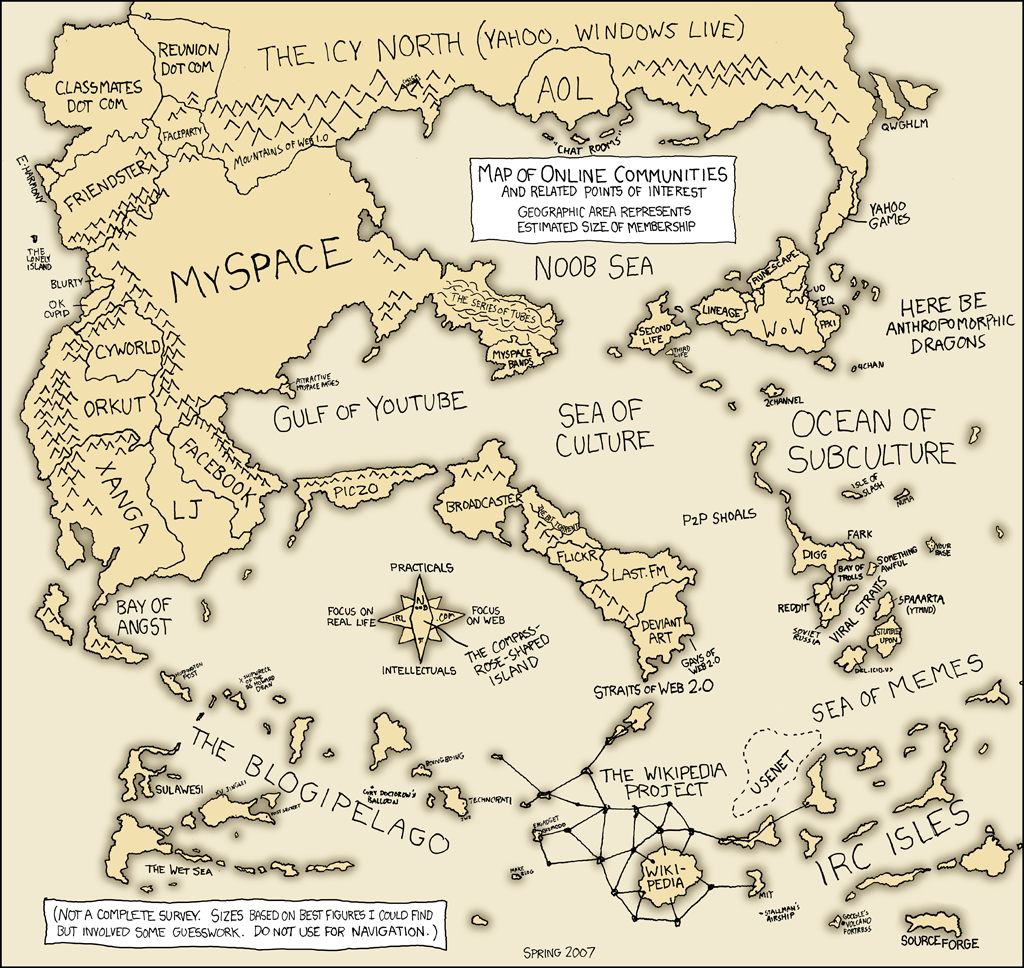
Hi folks -- lots of stuff going on of interest in the online community world today. First, check out this cartoon:
Be sure to click through to see the full-sized image; there are a lot of little outposts you might otherwise miss. And if you don't know what a community is (there are a bunch of niche ones), you're probably not a member of it.
(Of course, blogger John beat me to it.)
Two notes:
1. Naturally, AOL has a presence; the map is done in rough scale (see the note in the lower left), but I would be interested to see what data Mr. Munroe was pulling from, as "AOL" community covers everything from what we traditionally think of AOL community products (chat rooms, message boards, Journals), as well as other stuff, like the Weblogs, Inc. and other group blogs, Userplane Web community applications, and of course, everything that lives under AIM.
2. His cartoons are available under a Creative Commons Attribution-NonCommercial 2.5 license. If you're not familiar, Creative Commons is a modification to copyright that gives content creators more flexiblity in how they allow other people to be able to reprint, remix, or otherwise use their stuff.
As they say on their Web site, "You can use CC to change your copyright terms from 'All Rights Reserved' to 'Some Rights Reserved.'"
Since AOL is a commercial entity (not to mention a big target), my reproduction of the full cartoon might not pass the "noncommercial" test (different people have differing views on this depending on whether money actually changes hands, though we hew to a pretty conservative -- and restrictive -- interpretation); however, according to his terms of use page, you just have to ask him for permission (which I had previously done when I featured one of his cartoons over in my AIM Pages blog).
For other examples of Creative Commons in use, check out Ficlets, which is built on the Attribution-ShareAlike 2.5 license.
Entries in Progress -- Feedback Wanted
I have other entries on a user revolt at Digg, and an entry reacting to this Washington Post story from Monday, "Sexual Threats Stifle Some Female Bloggers", which I will talk more about later today.
If you've blogged about any of these issues, leave me a comment or send me a link at my JournalsEditor@aol.com address and I'll take a look and see if I can work it into my entries.
Thanks -- Joe
Map of online community done by cartoonist Randall Munroe at xkcd.com

Be sure to click through to see the full-sized image; there are a lot of little outposts you might otherwise miss. And if you don't know what a community is (there are a bunch of niche ones), you're probably not a member of it.
(Of course, blogger John beat me to it.)
Two notes:
1. Naturally, AOL has a presence; the map is done in rough scale (see the note in the lower left), but I would be interested to see what data Mr. Munroe was pulling from, as "AOL" community covers everything from what we traditionally think of AOL community products (chat rooms, message boards, Journals), as well as other stuff, like the Weblogs, Inc. and other group blogs, Userplane Web community applications, and of course, everything that lives under AIM.
2. His cartoons are available under a Creative Commons Attribution-NonCommercial 2.5 license. If you're not familiar, Creative Commons is a modification to copyright that gives content creators more flexiblity in how they allow other people to be able to reprint, remix, or otherwise use their stuff.
As they say on their Web site, "You can use CC to change your copyright terms from 'All Rights Reserved' to 'Some Rights Reserved.'"
Since AOL is a commercial entity (not to mention a big target), my reproduction of the full cartoon might not pass the "noncommercial" test (different people have differing views on this depending on whether money actually changes hands, though we hew to a pretty conservative -- and restrictive -- interpretation); however, according to his terms of use page, you just have to ask him for permission (which I had previously done when I featured one of his cartoons over in my AIM Pages blog).
For other examples of Creative Commons in use, check out Ficlets, which is built on the Attribution-ShareAlike 2.5 license.
Entries in Progress -- Feedback Wanted
I have other entries on a user revolt at Digg, and an entry reacting to this Washington Post story from Monday, "Sexual Threats Stifle Some Female Bloggers", which I will talk more about later today.
If you've blogged about any of these issues, leave me a comment or send me a link at my JournalsEditor@aol.com address and I'll take a look and see if I can work it into my entries.
Thanks -- Joe
Tuesday, May 1, 2007
[HEADLINE GOES HERE], 11 Blog Tips, and the Webby Awards
Hi folks -- Happy May, which according to the 2007 Bad Usability Calendar is "Use real content in your prototypes"-month:
* "What's Wrong With My Blog?" -- Stuart Brown at the Modern Life blog has 11 tips on how to build readership after you've created your blog.
The article is geared towards people who're specifically trying to attract an audience (especially those people who are trying to monetize their blogging), so the tips may or may not be useful to you. It's a quick read, though, so check it out (the entry is also notable for its REALLY BIG FONT. Don't get me wrong, I hate too-tiny type. But this entry shows that it's possible to go too far in the other direction.)
[Link via ProBlogger.Net]
* Also, the 2007 Webby Award Winners were announced. They're essentially irrelevant, but I don't find them nearly as rage-inducing as the Bloggies.
* BULLET 3 GOES HERE
* BULLET 4 GOES HERE
[That's a joke, people. Also, remember folks -- swearing in your placeholder text is high-larious... until it accidentally goes live.]
Thanks -- Joe
Download the 2007 Bad Usability Calendar here.

* "What's Wrong With My Blog?" -- Stuart Brown at the Modern Life blog has 11 tips on how to build readership after you've created your blog.
The article is geared towards people who're specifically trying to attract an audience (especially those people who are trying to monetize their blogging), so the tips may or may not be useful to you. It's a quick read, though, so check it out (the entry is also notable for its REALLY BIG FONT. Don't get me wrong, I hate too-tiny type. But this entry shows that it's possible to go too far in the other direction.)
[Link via ProBlogger.Net]
* Also, the 2007 Webby Award Winners were announced. They're essentially irrelevant, but I don't find them nearly as rage-inducing as the Bloggies.
* BULLET 3 GOES HERE
* BULLET 4 GOES HERE
[That's a joke, people. Also, remember folks -- swearing in your placeholder text is high-larious... until it accidentally goes live.]
Thanks -- Joe
Subscribe to:
Posts (Atom)